


The Federal Government of Nigeria has launched a comprehensive strategy to help farmers meet international standards for agricultural exports, particularly in line with the European Union Deforestation Regulation (EUDR). The initiative aims to protect export revenue, enhance environmental monitoring, and empower rural farmers while ensuring Nigeria’s commodities remain competitive in global markets.
Minister of Agriculture and Food Security, Abubakar Kyari, described the strategy as a forward-looking blueprint focused on traceability systems, deforestation-free supply chains, and capacity-building for smallholder farmers. “This national strategy will protect Nigeria’s export revenue, strengthen climate commitments, and ensure that rural communities are not excluded from the global supply chain,” he said.
The EUDR requires commodities to be traceable to the exact farm boundary, legally produced, and verifiably deforestation-free. Kyari warned that non-compliance could result in losses exceeding $1 billion in direct export earnings annually, with total economic impacts potentially exceeding $3 billion.
To implement the strategy, the Ministry of Agriculture will collaborate with the National Space Research and Development Agency (NASRDA) to provide satellite imagery, real-time monitoring, and technical support. Kyari explained that integrating geospatial technology, AI, and blockchain-enabled financing solutions could turn regulatory compliance into a competitive advantage for Nigerian farmers.
NASRDA Director-General Mathew Adepoju confirmed the agency’s commitment to providing the technical backbone for a modern, traceable, and deforestation-free agricultural supply chain. Meanwhile, Permanent Secretary Dr. Marcus Ogunbiyi highlighted the importance of integrated pest and disease management, noting that emerging threats like Fall Armyworm, Tuta absoluta, and Ginger blight continue to challenge crop productivity and rural livelihoods.
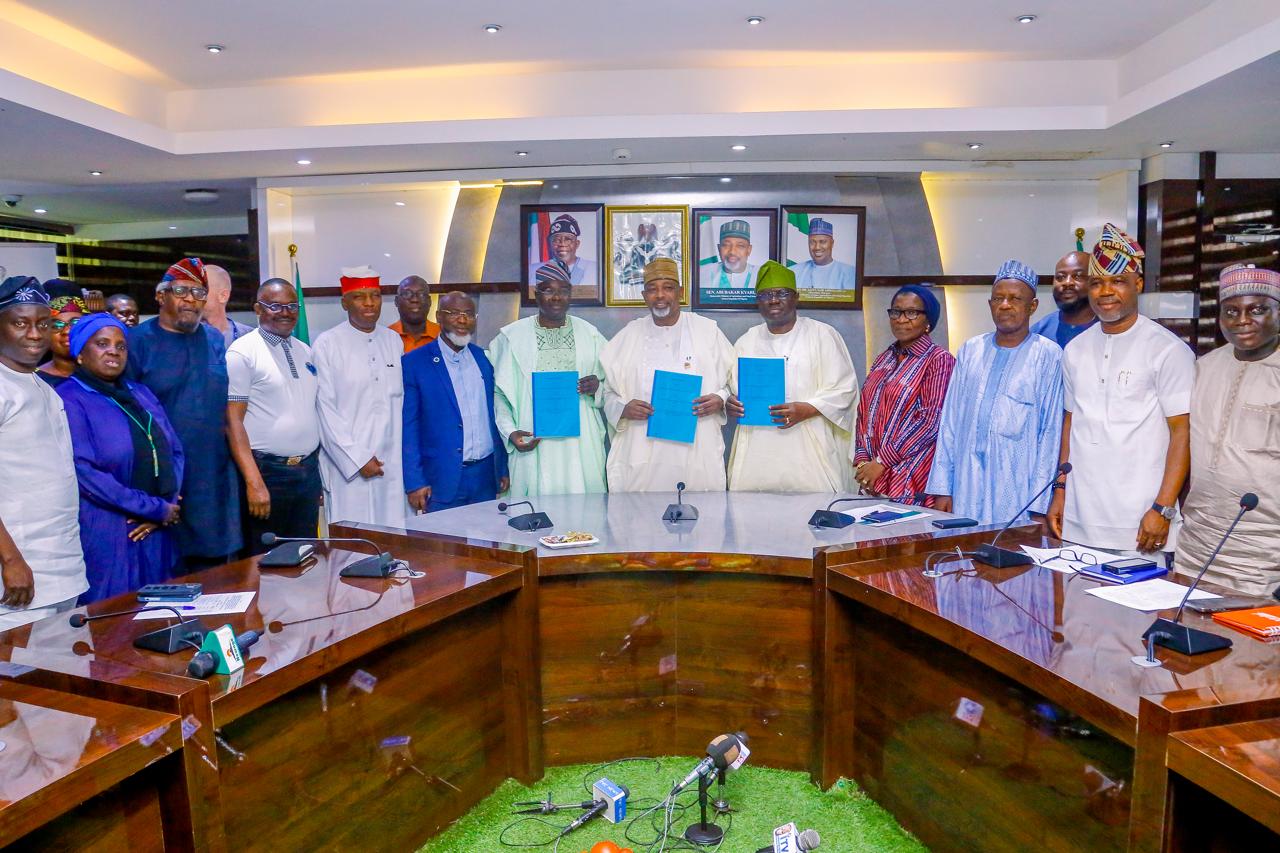
The strategy combines policy reform, technological innovation, and farmer engagement to strengthen Nigeria’s agricultural sector. A key milestone at the launch was the signing of a memorandum of understanding between the Ministry of Agriculture and NASRDA, establishing a national framework for farmland monitoring, traceability, and deforestation-free verification.
Minister Kyari emphasised that the framework would support smallholder farmers, ensuring they remain active participants in global supply chains. “By implementing this white paper, Nigeria can safeguard export revenue, strengthen climate commitments, and empower rural communities to thrive,” he said.
The initiative integrates advanced technologies, robust pest management, and institutional collaboration to create a resilient, sustainable agricultural system capable of meeting global market demands. With these measures, Nigeria is positioning itself as a model for other developing countries pursuing sustainable agricultural transformation while protecting the environment and improving the livelihoods of millions of farmers.