

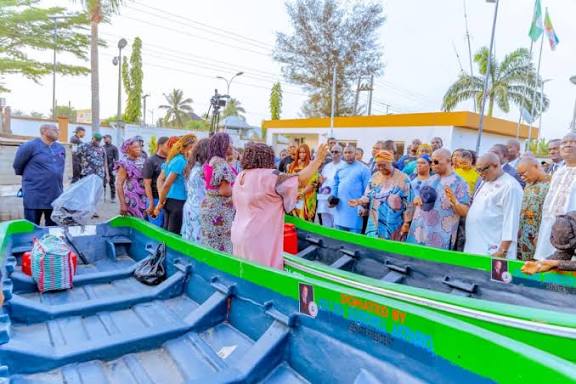
Women in riverine communities of Akwa Ibom State have received a boost to their livelihoods following the donation of fully equipped fishing boats aimed at strengthening local economic activity and food production in coastal areas.
The intervention, carried out on Boxing Day at the country home of the Senate President in Ukana, Essien Udim Local Government Area, formed part of an ongoing constituency empowerment programme focused on grassroots development and income generation. The initiative targeted women and cooperative groups from riverine communities where fishing remains the backbone of household income and local commerce.
A total of 10 outboard engine fishing boats were presented to beneficiaries drawn from coastal and riverine areas known for intensive fishing activities. The goal, according to organisers, was to improve productivity, enhance safety on waterways, and reduce the daily operational challenges faced by small-scale fishers, particularly women who dominate fish processing and distribution across the state.
Each boat was delivered with essential equipment required for modern fishing operations, including fishing nets, fuel tanks and refrigerators for fish preservation. The boats were fitted with durable engines suitable for open water use, with larger vessels powered by twin 75-horsepower engines and smaller boats equipped with 40-horsepower engines. The configuration was designed to reflect the different operating conditions and needs of the beneficiary communities.
Speaking during the presentation, the Senate President emphasised that effective empowerment should focus on providing tools that enable sustainable income generation rather than short-term financial support. He noted that riverine communities play a critical role in food supply and local trade, and that supporting women in the fishing value chain would have a direct impact on household welfare and economic stability.
He explained that the programme was structured to help beneficiaries expand their operations, reduce risks associated with outdated equipment, and improve earnings over time. According to him, strengthening women-led fishing activities would also reinforce local food supply chains and build resilience within coastal economies in the state.
The wife of the Senate President also addressed the gathering, describing the initiative as a practical response to the realities of life in riverine areas where access to modern tools often determines income levels. She noted that providing fishing boats and preservation equipment would ease the physical burden of work, improve efficiency and reduce post-harvest losses that often undermine small-scale fishing businesses.
She added that access to refrigeration and better storage would allow women to preserve their catch for longer periods, negotiate better prices and minimise waste associated with traditional preservation methods, thereby improving profitability and income stability.
Beneficiaries described the support as timely and transformative, explaining that many women had previously relied on rented or outdated boats that limited their range of operation and exposed them to safety risks. They said the new boats and equipment would enable them to increase daily catch volumes, operate more confidently on the waterways and stabilise income for their families.
One beneficiary representative said the intervention would allow them to work with greater dignity and independence, adding that the equipment would help grow their operations and deliver long-term benefits to their households and communities.