

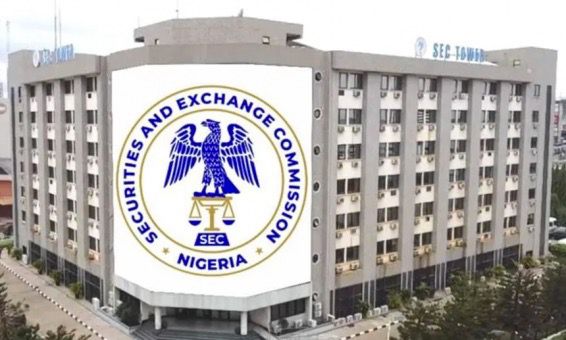
The Securities and Exchange Commission (SEC) has announced a revised minimum capital framework for Nigeria’s capital market, significantly raising capital thresholds for exchanges, market operators, fund managers, and technology-driven platforms. All regulated entities are required to comply by June 30, 2027.
Under the new rules, composite securities exchanges must raise capital to N10 billion from N500 million, while central counterparties (CCPs) now operate with N10 billion, up from N5 billion. Clearing and settlement companies are required to maintain N5 billion (previously N200 million), and non-composite exchanges must meet N5 billion.
The SEC said the revision aims to strengthen market resilience, enhance investor protection, and align capital adequacy with the evolving risk profile of market activities.
Capital floors for brokers, dealers, and broker-dealers have also increased. Brokers (client execution only) must now maintain N600 million, up from N200 million; dealers (proprietary trading) N1 billion, up from N100 million; while broker-dealers and inter-dealer brokers are required to hold N2 billion, rising from N300 million and N50 million, respectively.
In the asset management sector, a tiered structure applies based on scale. Tier-1 fund and portfolio managers with assets above N20 billion must maintain N5 billion, up from N150 million. Managers with over N100 billion in assets must hold 10 per cent of net asset value or assets under management as capital. Tier-2 managers must maintain N2 billion, private equity fund managers N500 million, and venture capital managers N200 million.
Issuing houses, registrars, trustees, and underwriters also face higher capital requirements. Issuing houses with underwriting obligations must maintain N7 billion, while those without underwriting must hold N2 billion. Registrars are required to maintain N2.5 billion, up from N150 million, and underwriters N5 billion.
The framework also covers digital and commodity markets. Digital asset exchanges and custodians are required to maintain N2 billion, digital asset offering and real-world asset tokenisation platforms N1 billion, warehousing operators N500 million, and collateral management companies between N200 million and N500 million, depending on scope.
The SEC emphasized that the changes aim to enhance operational resilience, mitigate systemic risk, and support orderly growth, including in digital and commodities markets. Non-compliance after June 2027 may result in suspension or withdrawal of registration.
Replacing the 2015 framework, the new regime introduces some of the highest entry and operating thresholds in Nigeria’s capital market, paving the way for recapitalisation, possible consolidation, and tighter prudential oversight ahead of the 2027 deadline.