Nigeria has invested more than $50 million in biotechnology research and climate-resilient seed development in the last two years as part of efforts to raise agricultural productivity and strengthen agribusiness value chains.
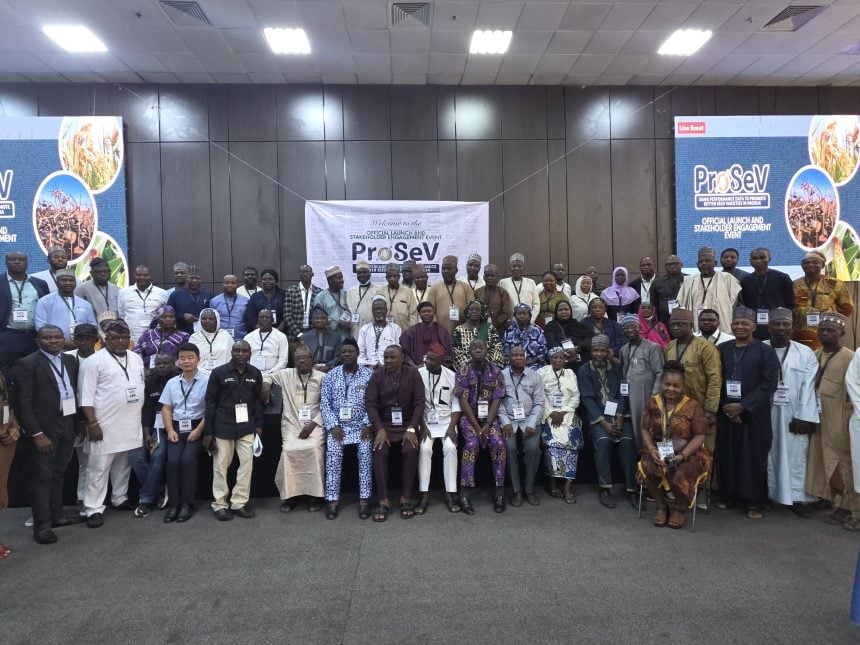
The Director General of the National Agricultural Seeds Council, Fatuhu Muhammed, disclosed this at the official launch of the ProSeV Project during a stakeholders’ engagement, where he spoke on variety adoption and its role in transforming agribusiness in Nigeria.
Muhammed described seed as the most critical input in agriculture, stressing that the adoption of improved varieties is essential to moving Nigeria from subsistence farming to a competitive and investment-ready agricultural sector. According to him, improved seeds deliver higher yields, better nutrition, pest resistance, climate resilience and more sustainable farming systems.
He noted that as climate risks increase and food demand rises, seed technology will increasingly determine how countries address food security and agricultural sustainability. However, he said agribusiness planning in Nigeria has been weakened by poor data on which seed varieties farmers actually plant and how those varieties perform after release.
The reliance on farmer recall and visual identification, he explained, often fails to reflect realities on farms, creating uncertainty for seed producers, processors, investors and policymakers. To close this gap, NASC has introduced the IMAGE Project, which applies DNA fingerprinting to accurately identify seed varieties grown by farmers and track their movement across the seed system.
This approach, Muhammed said, brings accuracy, objectivity and credibility into Nigeria’s seed and agribusiness ecosystem. Through nationwide surveys covering crops such as rice, maize, cassava and cowpea, NASC has generated field-level data on adoption patterns and sources of planting materials across different agro-ecological zones.
He explained that the data is already helping agribusinesses forecast raw material supply, enabling investors to better assess risk, supporting regulators in tackling counterfeit seeds, and improving confidence among financial institutions funding agriculture.
Nigeria’s seed sector, he added, has recorded measurable progress in recent years. More than 120,000 metric tonnes of certified seeds have been distributed, benefiting millions of smallholder farmers. The Digital Seed Distribution System introduced in 2021 has reduced distribution costs by about 25 per cent while improving efficiency and traceability.
Nigeria–Netherlands Seed Programme have also led to the release of over 20 new seed varieties in the last two years, including drought-tolerant, pest-resistant and high-yield crops. Muhammed noted that women now account for 35 per cent of certified seed users, while over 2.5 million farmers have received training in good agricultural practices and seed management.
Looking ahead, he said the $50 million investment in biotechnology has supported the development of pest-resistant cassava, drought-tolerant millet and high-yield rice varieties. Partnerships with global research institutions such as the International Institute of Tropical Agriculture and the CGIAR are accelerating innovation in seed breeding and climate resilience.
He added that reforms such as the Plant Variety Protection Act and NASC’s membership in global seed bodies including UPOV, ISTA and OECD Seed Schemes are positioning Nigeria as a leading seed market in Africa.
In a welcome address, Dr Isaiah Gabriel of the Foundation for Sustainable Smallholders Solutions said many farmers struggle not due to lack of effort but because of limited access to reliable information. He explained that the ProSeV Project, supported by the Bill & Melinda Gates Foundation, is designed to replace guesswork with performance-based data that helps farmers choose seed varieties suited to their land, climate and market needs.
Muhammed concluded that variety adoption sits at the intersection of science, markets and investment, adding that data-driven seed systems remain key to unlocking Nigeria’s full agribusiness potential.