If you’re part of a youth-led organisation passionate about restoring degraded environments from farmland, forests, grasslands, to urban green spaces, coasts, and wetlands then the UN Decade Youth Task Force Microgrant 2026 offers you a chance to turn vision into action. The call supports young environmental stewards globally, offering seed funding to implement community-driven ecological restoration projects.
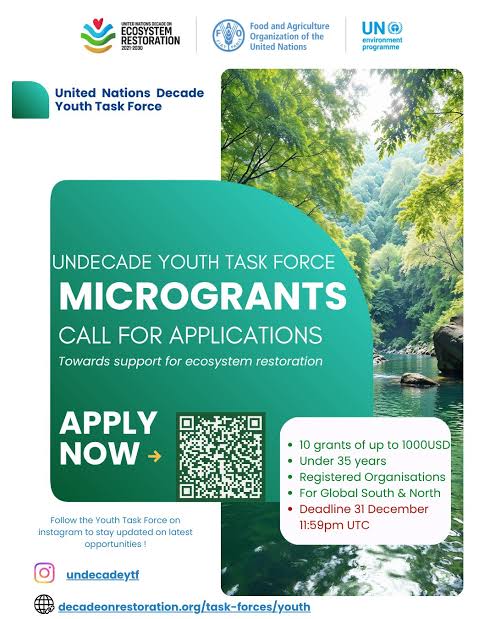
With 10 microgrants of up to USD 1,000 each available, this is both a small-scale funding boost and a chance for young changemakers to contribute meaningfully to ecosystem recovery.
What the Microgrant Supports (Focus Areas & Goals)
The program funds youth-led initiatives targeting restoration, conservation, or protection of ecosystems under the remit of the UN Decade on Ecosystem Restoration. Eligible ecosystem categories include:
Farmlands & Agricultural Landscapes
Forests and Woodlands
Freshwater and Wetlands
Grasslands, Savannahs, Shrublands
Mountains & Highland Ecosystems
Coastal Zones, Oceans & Marine Areas
Peatlands
Urban or peri-urban green / natural spaces
Projects should aim to deliver measurable ecological or social-environmental benefits, such as: reforestation or tree planting, soil restoration, biodiversity enhancement, water-quality improvement, or community-based conservation and climate resilience.
Who Can Apply (Eligibility Requirements)
Youth-led organisations (not individuals) with legal registration.
Leadership team / project leads must be under 35 years old.
Projects must target one or more of the defined ecosystem categories.
Applicants must submit a complete project proposal with: summary, methodology/plan, timeline, sustainability plan, environmental-impact indicators, detailed budget, and proof of registration.
Budget request per project is up to USD 1,000.
What is not eligible:
The grant will not fund conferences, workshops, salaries/honoraria, tuition, or equipment not directly tied to restoration activities.
Key Dates & Grant Period
✅ Application Deadline: 31 December 2025 (by 23:59 UTC)
📅 Grant Period: Implementation of funded projects expected between February and July 2026.
📣 Number of Grants: 10 microgrants (total funding envelope approx. US$10,000)
🌍 Geographic Distribution: 80% of grants reserved for projects in the Global South; 20% for the Global North.
Fill in the online application form — providing organisation details, project plan, ecosystem targeted, proposed activities and outcomes.
Attach required documents: legal registration certificate, team profile (leaders under 35), project proposal with SMART objectives, implementation timeline, budget, environmental/social impact plan.
Ensure your plan follows nature-based, evidence-driven restoration methods using native species and includes community/youth engagement components.
Submit before 31 December 2025, 23:59 UTC. Late or incomplete applications will be disqualified.
Shortlisted applicants will be notified ~mid-January 2026. Implementation of projects then begins between Feb–July 2026.
Why It’s a Great Opportunity for Youth-Led Organisations
It offers accessible start-up funding — USD 1,000 may be small, but it’s enough to pilot restoration, plant trees, mobilise communities, or restore degraded land/forests.
It encourages youth leadership and community engagement, meaning young people not just established NGOs, can lead meaningful environmental change.
It supports diverse ecosystems, giving flexibility whether you’re working in urban greening, coastal protection, freshwater restoration, forest/woodland recovery, or farmland regeneration.
It promotes scalable and replicable restoration models, ideal for demonstration projects that can later attract more funding or scale-up locally or regionally.
The initiative aligns with global climate and sustainability goals (through the UN Decade on Ecosystem Restoration), giving legitimacy and visibility to your project.