

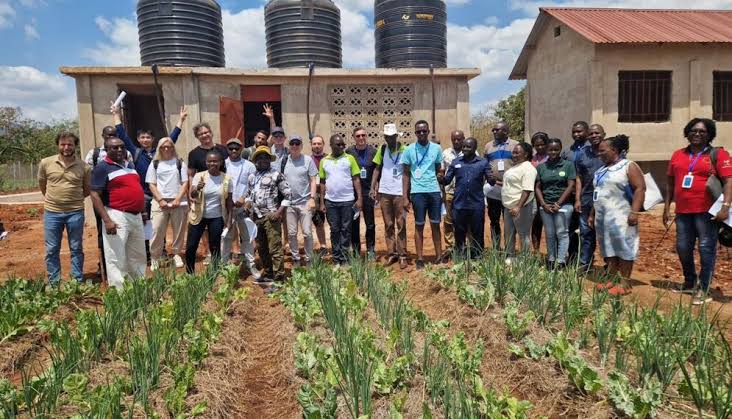
An EU-backed agroecology project, PrAEctiCe, has introduced a digital decision support tool designed to help smallholder farmers in Nigeria make better, data-driven decisions as they transition to sustainable farming practices.
The project has developed a mobile application for farmers that delivers real-time insights on farm conditions, helping users respond appropriately to changes in their crops, fish stock and overall farm environment. The application also simplifies communication between farmers and agroecology advisors, ensuring that technical guidance is easily accessible when needed.
Through the app, farmers can access farm, crop and fish data generated from questionnaires and monitoring systems installed at farm gates. These systems collect and analyse key parameters such as soil conditions, water quality and crop health, providing timely alerts that support day-to-day farm management. According to Apodissi’s general manager, Margherita Trestini, the monitoring installations enable real-time data tracking that benefits both farmers and advisors by improving the accuracy of on-farm decisions.
Alongside the farmers’ application, the project has developed a dedicated tool for advisors, focusing on technical data collection and analysis. The advisor platform integrates sensor data from soil and water monitoring systems and features an interactive map that shows farm locations and infrastructure. This allows advisors to visualise conditions across multiple farms, track performance indicators and respond quickly to emerging issues.
Advisors are responsible for creating and managing indicators and alerts based on sensor readings and field data, translating complex information into clear, practical guidance for farmers. Trestini explained that while advisors manage and interpret real-world measurements, farmers rely on these insights to take timely actions that protect productivity and sustainability.
The digital tools were developed under the Horizon Europe programme using a co-creation approach that involved agroecology stakeholders throughout the process. Early stages of the project focused on identifying barriers and drivers of agroecological transition, as well as adapting indicators to reflect differences in agricultural zones and climate conditions across East Africa.
The framework was later expanded to include climate change mitigation and adaptation impacts, alongside the financial viability of smallholder farms. Based on these findings, data were refined with input from experts within and outside the project consortium.
The project noted that these refined insights were then applied to the final design of the decision support tool, with user feedback incorporated to improve system efficiency, performance and visual analytics. For smallholder farmers and agri-focused MSMEs, the tool represents a practical step towards smarter resource use, improved resilience and more sustainable farm businesses.