

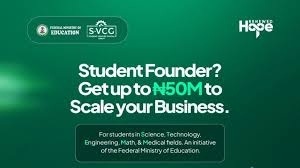
The Federal Government has unveiled a N50 million Student Venture Capital Grant to promote innovation, research excellence, and entrepreneurship across Nigeria’s tertiary institutions. The launch took place in Abuja on Monday, with the Minister of Education, Tunji Alausa, describing the programme as a strategic investment in young innovators and a key part of the Renewed Hope Agenda for Education. He said the S-VCG goes beyond funding by nurturing high-potential campus ideas and building a culture of enterprise and creativity among students.
Under the scheme, beneficiaries will receive up to N50 million in equity-free seed funding, incubation support, expert mentorship, and access to vital startup development tools and networks. The programme is being implemented by the Federal Ministry of Education and TETFund in partnership with the Bank of Industry, Afara Initiative, Afrilabs, the Entrepreneurship and Skills Development Centre, and Google. It is open to full-time students in federal, state, and private tertiary institutions from Year 3 upward, although younger students may join as team members. Eligible projects must be CAC-registered and rooted in STEM and medical science disciplines.
Alausa explained that applicants will be evaluated through a rigorous screening process, with shortlisted teams pitching before a 12-member expert panel drawn from industry, academia, venture capital, and government. Participants will receive feedback and may be paired with complementary teams to foster collaboration and shared innovation. He noted that the scheme is expected to fast-track research commercialisation, strengthen intellectual property development, and enable students to build viable high-impact solutions with global relevance. While not every idea will become a startup, some may evolve into patents or licensable technologies of significant economic value.
Giving programme updates, the National Programme Coordinator, Adebayo Onigbanjo, said the initiative aims to bridge investment gaps that have long hindered early-stage university innovation. He disclosed that the platform has recorded 17,914 sign-ups from 402 institutions, including 346 public and 56 private schools, with over 1,000 applications already submitted. At the event, former Power Minister Barth Nnaji praised the initiative and highlighted its alignment with broader efforts to strengthen research and innovation in Nigeria, particularly in science-driven problem solving.
The application portal opened on November 17 and will close on January 23, 2026, after which evaluation and screening will begin. For MSMEs and young entrepreneurs, especially those operating within university communities, this policy signals an opportunity to access funding, build innovative products, and possibly transition into scalable enterprises. With structured mentorship and incubation built into the programme, the scheme could stimulate startup growth, improve job creation, and encourage more youths to pursue research-backed solutions to local problems.