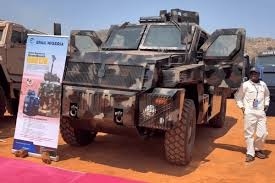
The Federal Government has added a new armoured fleet, procured mine-resistant ambush-protected vehicles (MRAP), and refurbished over 100 Armoured Fighting Vehicles (AFVs) to bolster Nigeria’s security apparatus. The announcement was made on December 15, 2025, by Stanley Nkwocha, Senior Special Assistant to the President on Media & Communications (Office of the Vice President).
The move forms part of President Bola Ahmed Tinubu’s broader strategy to modernise the Nigerian Armed Forces and respond to escalating security threats across the country. At the Chief of Army Staff Annual Conference 2025 in Lagos, Vice President Kashim Shettima, representing the President, reaffirmed the administration’s commitment to deploying all military and law enforcement resources to safeguard lives and property.
“There is no nation that can achieve greatness without security. This government remains resolute in mobilising all military and law enforcement assets to eliminate security threats and protect the lives and property of all Nigerians,” the Vice President said.
President Tinubu highlighted improvements in training, operational capacity, and equipment procurement. The armed forces have received additional MRAPs, armoured vehicles, and patrol units, while over 100 refurbished AFVs have been returned to active service. Helicopters have also been inducted into the Nigerian Army Aviation, with pilots fully trained to support operations.
The President noted ongoing collaborations with international partners to foster research, innovation, and indigenous defence production, aiming for long-term self-reliance in security and defence.
Chief of Army Staff, Lieutenant General Waidi Shaibu, unveiled welfare packages designed to boost morale and operational effectiveness. He commended the government for meeting the Army’s operational needs and called on officers to uphold professionalism and discipline. Fifteen Toyota Hilux vehicles were awarded to warrant officers, and cheques were handed to families of five fallen soldiers under the Nigerian Army Personnel Insurance Scheme.
The development comes as Nigeria continues to face rising insecurity, including kidnappings, banditry, and violent attacks on schools and places of worship. Former presidential candidate Peter Obi criticised the government’s handling of security, citing persistent violence and underutilised intelligence systems despite substantial public spending.
In response, the government has raised the target for the Nigeria Police Force recruitment from 30,000 to 50,000 officers to strengthen frontline capacity. State police structures have also been authorised to empower subnational authorities to tackle local security challenges. Officers in non-core roles are being redeployed to frontline duties, while the Department of State Services is deploying specially trained forest guards to combat armed groups in rural and forested areas.
Additionally, the National Economic Council approved a N100 billion fund to rehabilitate training institutions for police and security agencies, aiming to enhance professional standards, operational readiness, and the overall effectiveness of personnel across the country.