

Mennonite Economic Development Associates has launched a five-year agricultural development initiative aimed at strengthening agri-food value chains and expanding decent job opportunities for women and youth in Northern Nigeria.
The project, known as the Resilient and Inclusive Agri-Food Systems Empowering Women and Youth in Nigeria initiative, or RISE, is supported by Global Affairs Canada and is expected to create about 8,000 sustainable jobs across Bauchi, Kaduna and Kano states. Beyond job creation, the initiative will directly support 12,500 smallholder farmers by improving access to finance, promoting climate-smart agricultural practices and strengthening linkages to markets.
Unveiled on Thursday, January 22, 2026, the RISE project is positioned as a major boost for small and medium-scale agribusinesses in the region, particularly those led by women and young people. The programme will strengthen 450 women- and youth-owned enterprises and support 250 farmer cooperatives, with an estimated total reach of about 50,000 beneficiaries across the three states.
Implementation will focus on key value chains including rice, maize, groundnut and soybean, commodities that play a critical role in food security, rural employment and MSME growth in Northern Nigeria. By targeting both production and enterprise development, the project seeks to address long-standing bottlenecks that limit productivity, profitability and resilience for smallholder farmers and agribusiness owners.
The RISE initiative is built around a three-pillar approach that links improved farm productivity to enterprise growth and social inclusion. It aims to raise yields and incomes for smallholder farmers through climate-smart innovations, enhance the competitiveness of women- and youth-led agribusinesses through better access to finance and technology, and address harmful social norms by promoting inclusive leadership within cooperatives and agribusiness enterprises.
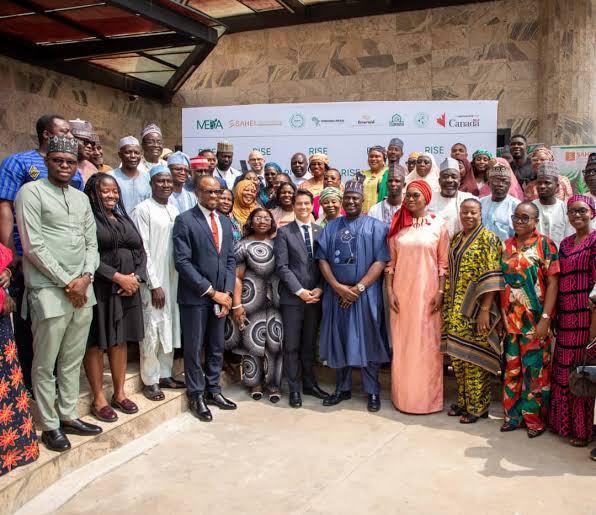
At the launch event, stakeholders from government, the private sector, financial institutions, women’s groups and farmer cooperatives discussed systemic challenges affecting the targeted value chains and explored ways to unlock sustainable growth for local agribusinesses.
Speaking at the event, MEDA’s Regional Director for West and Central Africa, Diaka Diallo Sall, said the project places women and youth at the centre of agricultural transformation in Northern Nigeria. She noted that the initiative is designed not only to improve resilience to climate and economic shocks but also to expand opportunities for smallholder farmers, cooperatives and agri-food enterprises to grow and compete.
She stressed that women and youth are positioned as leaders and drivers of change within the agri-food ecosystem, rather than passive beneficiaries of development support.
Canada’s High Commissioner to Nigeria reaffirmed the country’s commitment to Nigeria’s agricultural development, describing agriculture as a critical driver of economic growth, poverty reduction and gender equality. He said empowering women and youth across agri-food systems is key to creating decent jobs, strengthening local economies and building more resilient and sustainable food systems.
The launch also featured panel discussions moderated by development experts, with women farmers sharing practical perspectives on the challenges and opportunities within Northern Nigeria’s agricultural landscape.
The RISE project is co-designed and implemented by MEDA in partnership with Sahel Consulting, Development Exchange Centre, Emeraid Capital, Extension Africa, Women in Business Forum and the Federation of Muslim Women’s Associations in Nigeria. Senior government officials from federal and state ministries of agriculture, women affairs and economic planning were also in attendance, underscoring growing public-private collaboration around inclusive agricultural growth.
By linking smallholder farmers, cooperatives and MSME agribusinesses to finance, markets and inclusive leadership structures, the RISE initiative is expected to contribute significantly to the transformation of Northern Nigeria’s agri-food systems over the next five years.