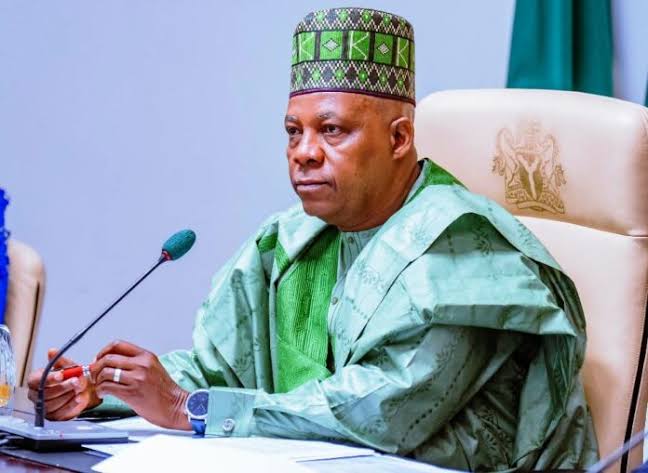
Nigeria has shifted its approach to food security, treating it as a core macroeconomic, security and governance priority rather than a narrow agricultural concern, the Vice President said on Thursday at a high-level panel at the World Economic Forum meeting in Davos, Switzerland.
Speaking at a session titled When Food Becomes Security, the Vice President said the Federal Government has begun a multidimensional agricultural drive designed to shield the economy from global shocks, curb inflationary pressures and restore productivity in key food-producing regions across the country.
According to him, food security now sits at the heart of Nigeria’s national security and economic planning, with the government positioning it as a tool for stability, regional cohesion and long-term growth. He said the country’s strategy is built around expanding food production, ensuring environmental sustainability and deepening regional integration within West Africa.
Global supply chain disruptions and rising climate pressures, he explained, have compelled Nigeria to rebuild its agricultural base by developing resilient food systems tailored to its diverse ecological zones. He noted that the country’s size and ecological diversity mean economic outcomes are closely linked to environmental realities, with desertification, deforestation and drought affecting the Sahelian North, while flooding remains a major challenge in the riverine South and parts of the North Central.
To respond, the government is promoting drought-resistant, flood-tolerant and early-maturing crop varieties, including rice, sorghum and millet, while redesigning food systems in flood-prone areas to withstand climate shocks. These measures, he said, are aimed at stabilising output and protecting livelihoods, especially for smallholder farmers who are most exposed to climate volatility.
Security challenges continue to weigh heavily on food production, as many conflict-affected areas double as major food baskets. The Vice President said the government is addressing this by creating food security corridors and strengthening community-based security engagements to enable farmers to return safely to their land and resume production.
He disclosed that the Back to the Farm Initiative has been launched to resettle displaced farmers and support them with inputs, insurance and access to capital, a move expected to revive local food supply chains and stimulate rural economies.
On the macroeconomic front, he identified Nigeria’s heavy reliance on food imports and foreign exchange volatility as key drivers of food inflation. Imports of wheat, sugar and dairy products, he said, have continued to exert pressure on prices, prompting the government to accelerate local production and promote substitutes such as sorghum, millet and cassava flour to address long-standing structural imbalances.
He stressed that aligning agriculture with inflation control, national stability and regional cooperation has become central to Nigeria’s economic response to both domestic and external shocks. For small businesses across the food value chain, from processors to distributors, he said the shift offers opportunities to scale local sourcing and reduce exposure to foreign exchange risks.
The Vice President also called on African countries to deepen cooperation under the African Continental Free Trade Area, describing stronger intra-African trade as a necessity amid changing global economic alignments. He expressed optimism that ongoing reforms under the current administration’s economic agenda would translate into scalable investments for smallholder farmers and fishers, improved climate adaptation and a boost in intra-African trade flows.