

The Nigerian Government has announced plans to co-host Investopia with the United Arab Emirates in Lagos in February, a move aimed at attracting global investors and accelerating sustainable investment flows into the country.
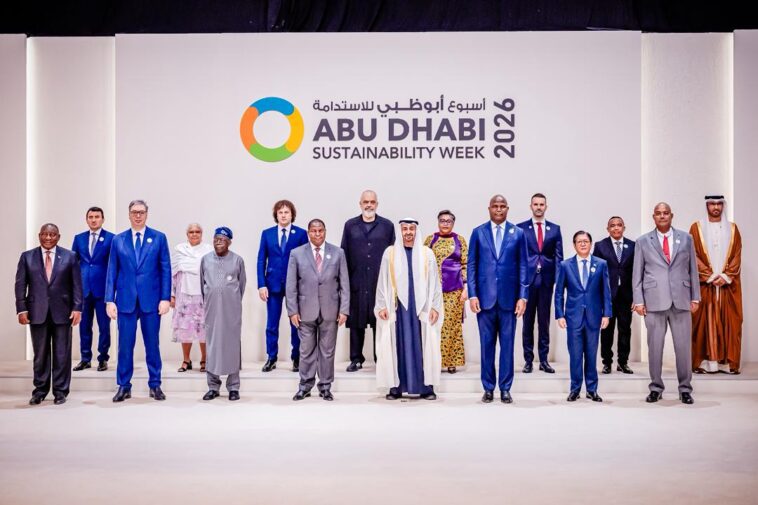
The announcement was made on Tuesday at the 2026 Abu Dhabi Sustainability Week, where Nigeria also concluded a Comprehensive Economic Partnership Agreement with the UAE to strengthen bilateral trade and cooperation across key growth sectors.
On the sidelines of the summit, the Nigerian Government and the UAE formalized the agreement in the presence of senior officials from both countries, including Nigeria’s Minister of Industry, Trade, and Investment, Dr. Jumoke Oduwole, and the UAE Minister of Foreign Trade, Dr. Thani bin Ahmed Al Zeyoudi. The agreement is expected to deepen collaboration in areas such as renewable energy, infrastructure, logistics, digital trade, aviation, agriculture, and climate-smart development.
According to the government, Investopia will serve as a global investment platform bringing together investors, policymakers, innovators, and business leaders, with Lagos positioned as a gateway for capital flows into Nigeria and the wider African market. The forum is expected to create opportunities for partnerships, financing, and deal-making, particularly in sectors critical to long-term economic growth.
Speaking at the event, the Nigerian Government said it is targeting the mobilisation of up to $30 billion annually in climate and green industrial finance as part of ongoing energy transition and economic reforms. Officials noted that electricity remains the backbone of industrialisation, stressing the need to balance economic growth with decarbonisation in a way that supports businesses and households.
The government also called for reforms to the global financial system, advocating blended finance and first-loss capital structures that would make it easier for private capital to flow into green and infrastructure projects without placing additional pressure on public finances.
As part of efforts to boost investor confidence, Nigeria has strengthened its climate governance framework through the adoption of a National Carbon Market Activation Policy and the launch of a National Carbon Registry. The government also highlighted the Electricity Act 2023, which allows decentralised power generation and distribution, particularly for underserved communities and business clusters.
Ongoing initiatives include a $500 million distributed renewable energy fund backed by the Nigeria Sovereign Investment Authority and a $750 million World Bank-supported programme expected to expand clean electricity access to more than 17.5 million people. These reforms are expected to lower energy costs, improve productivity, and support MSMEs that rely heavily on a stable power supply.
The government also invited investors to partner in Nigeria’s lithium and critical minerals sector, emphasising a policy focus on local processing and value addition to support industrial growth and job creation.
Highlighting the impact of recent reforms, officials said Nigeria has recorded a 21 percent increase in non-oil exports, alongside rising capital importation and more than $50 billion in investment commitments across key sectors.
With the co-hosting of Investopia and the signing of the trade agreement with the UAE, the Nigerian Government says it is positioning the country as a competitive destination for sustainable investment, trade expansion, and MSME-driven growth.