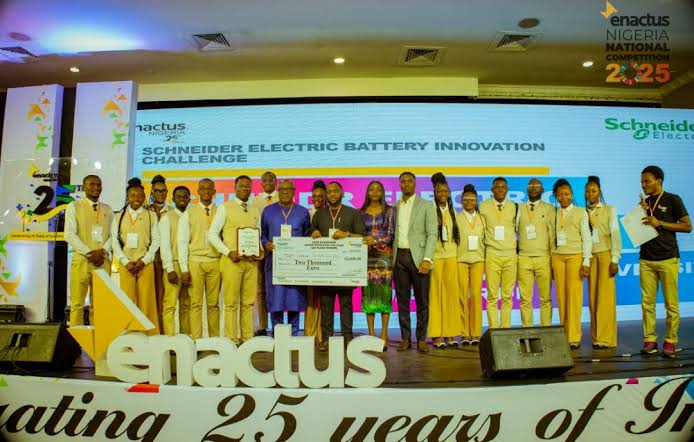
Schneider Electric and Enactus have unveiled the winners of the 2025 Battery Innovation Challenge, part of their youth empowerment initiative designed to support young innovators across English-speaking Africa in developing breakthrough battery technologies.
The programme, funded by the Schneider Electric Foundation, aims to empower students to create scalable energy solutions addressing pressing regional challenges. This year’s first-place winners came from South Africa, Kenya, Nigeria, and Zimbabwe, showcasing innovations with technical ingenuity, social impact, and commercial potential.
In South Africa, the University of the Witwatersrand’s BioWatt team developed a microbial fuel cell system generating electricity from organic waste while reducing e-waste. Kenya’s Strathmore University won with Afya Cell, an AI-powered battery health analyser extending battery lifespan for electric vehicles, solar systems, and IoT devices. Nigeria’s Joseph Sarwuan Tarka University claimed first place with Energiv, converting plastic waste into carbon nanotubes to enhance lithium-ion batteries. In Zimbabwe, the University of Zimbabwe’s LithiumX project created an eco-friendly method to recycle lithium-ion batteries. Each first-place team received €2,000 from the Schneider Electric Foundation.
The challenge also celebrated 2024 winners, who have successfully scaled their projects. In Zimbabwe, Bindura University’s VoltStep, a micro-battery module embedded in footwear, sold over 8,000 units and generated renewable energy for rural students. Kenya’s Afterlife team expanded their second-life battery repurposing project and formally registered as a company. In Nigeria, Repo evolved into Ecovolt, powering household appliances, creating 20 youth jobs, and selling 40 units. South Africa’s Airnergy & Tech Solutions commercialised the ElectroBoost300, a 300-watt portable power station.
Finalists from all participating countries demonstrated innovative approaches to sustainable energy. Nigeria’s Ahmadu Bello University developed Cell Matrix, a machine-learning-based battery management system, while Kaduna Polytechnic created SmartVolt, an adaptive charging algorithm optimising battery performance. Kenya, South Africa, and Zimbabwe also presented innovative solutions in recycling, hybrid systems, and biodegradable energy sources.
Marketing Communications and Corporate Citizenship Director, English-speaking Africa, Schneider Electric, Elihle Obi, emphasised the importance of technical support for youth innovation, while Enactus South Africa CEO Letitia de Wet highlighted the determination of African youth to shape a sustainable energy future.
The Battery Innovation Challenge underscores the potential of young African innovators to deliver clean energy solutions while creating opportunities for entrepreneurship, skills development, and job creation across the continent.