

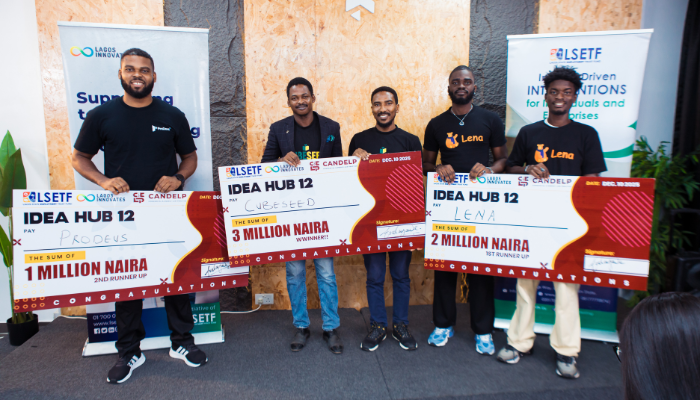
In a city where hustle doubles as a language, the Lagos State Employment Trust Fund has once again drawn a clear line between ideas that sound good and innovations that can survive Lagos. After eight intense weeks of mentoring, iteration and high-pressure problem-solving, the Lagos Innovate Idea Hub 12.0 has produced three standout startups, signalling where the next phase of the state’s tech-driven economy may be headed.
From thousands of applications, only 20 startups earned a place in the Idea Hub programme. By Demo Day, just six remained. What played out on that final stage was not a pitch competition in the conventional sense, but a showcase of solutions shaped by market stress, customer reality and the uniquely unforgiving business climate of Lagos.
At the top of the cohort was Cubeseed Africa, an agritech startup tackling one of the most persistent problems in Nigeria’s food system: trust. Farmers often face delayed payments or outright losses, while buyers struggle with inconsistent supply, poor quality and limited access to credit. Cubeseed positions itself as digital market infrastructure, connecting commercial livestock farmers directly to bulk buyers such as restaurants, hotels and coldroom operators. Through a partnership with a commercial bank, the platform guarantees instant payment for farmers and reliable protein supply for buyers, including access to credit. Beyond commerce, the model strengthens food security by restoring confidence to agricultural trade.
Closely following was Lena, an edtech startup confronting Africa’s learning crisis. Despite high school enrolment rates, many children still struggle with basic literacy and numeracy, a problem worsened by overcrowded classrooms that leave little room for personalised attention. Lena uses AI-powered, curriculum-aligned games to turn maths, literacy and science into interactive, story-driven experiences. Its adaptive tutor adjusts learning difficulty in real time, offering individualised support at scale. Built with a mobile-first and offline-friendly approach, the platform is designed for low-connectivity environments, positioning it to reach learners often excluded by conventional edtech solutions and to contribute to Africa’s long-term talent pipeline.
Another standout solution came from Prodevs, a startup focused on one of Lagos’ most chaotic markets: tech hiring. As demand for software developers continues to outpace supply, companies spend valuable time navigating inefficient recruitment processes. Prodevs streamlines access to vetted tech talent, allowing growing businesses to focus on scaling rather than sourcing, a service with clear implications for productivity and job creation in the digital economy.
The Demo Day atmosphere reflected more than startup enthusiasm. It underscored how local innovation continues to thrive despite shifts in global venture capital flows. According to the programme’s organisers, Idea Hub 12.0 is proof that Lagos still possesses the talent and resilience required to build businesses capable of competing beyond Nigeria’s borders.
For the Lagos State Government, the programme represents a deliberate economic strategy rather than a showcase event. By refining products, strengthening business models and exposing founders to industry mentors, LSETF reduces the risk typically associated with early-stage ventures. The result is a smaller pool of stronger companies with a higher chance of creating jobs and attracting investment.
As the winners of Idea Hub 12.0 move into the market, the message is clear. Innovation in Lagos is no longer about building apps for attention; it is about solving real problems at scale. And somewhere between Alausa and Yaba, the foundations of Nigeria’s next major growth story may already be taking shape.