

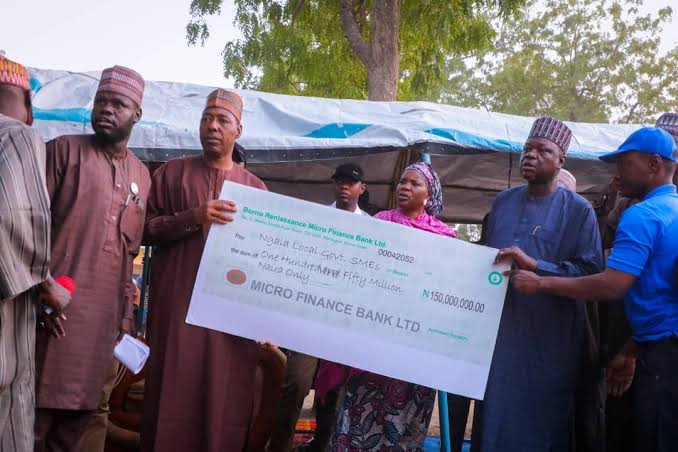
Borno State Governor Babagana Zulum has disbursed N1 billion in cash support to small and medium-scale enterprises across five local government areas in Borno South Senatorial District, reinforcing the state’s focus on grassroots economic recovery and self-reliance.
The disbursement, unveiled in Biu, targets entrepreneurs in Biu, Hawul, Shani, Bayo and Kwaya-Kusar, with the governor describing direct capital support as critical to rebuilding rural economies after years of insecurity. He said strengthening SMEs remains central to restoring livelihoods, boosting local production and reducing dependence on aid in post-insurgency communities.
Zulum noted that small businesses play a vital role in job creation and social stability, especially in areas recovering from conflict. By injecting funds directly into local enterprises, the government aims to improve business sustainability, expand household incomes and stimulate community-level economic activity.
Beyond the SME intervention, the governor ordered the immediate employment of 200 youths from Biu, linking the move to efforts to curb youth restiveness and promote long-term social stability. He also inaugurated a remodelled Second Chance School in Biu, designed to provide vulnerable girls and women with access to education, skills acquisition and digital knowledge, particularly those who missed formal schooling due to displacement or hardship.
The governor further announced the automatic employment of volunteer health workers during a visit to Biu Specialist Hospital, acknowledging their service and strengthening the local healthcare workforce. He also inspected a 100-unit teachers’ housing estate under construction, describing it as an incentive to attract and retain qualified teachers in public schools.
In addition, Zulum directed the immediate rehabilitation of the Borno State Hotel Annexe in Biu, a move expected to support local commerce and hospitality-related businesses once completed.
For MSMEs in southern Borno, the intervention signals a broader recovery strategy that combines enterprise funding, employment, education and social infrastructure. As security conditions improve, the state government is positioning small businesses as key drivers of inclusive growth, stability and long-term economic resilience.