• News
  • Business
  • Opportunities
    • Articles & Resources
  • Spotlight
  • Views
    • Interviews
    • Opinions
  • MSME Jobs
  • More
    • Africa
    • World
  • webmail
  • Terms of Use
MSME Africa
  • News
  • Business
  • Opportunities
    • Articles & Resources
  • Spotlight
  • Views
    • Interviews
    • Opinions
  • MSME Jobs
  • More
    • Africa
    • World
  • webmail
  • Terms of Use
No Result
View All Result
  • News
  • Business
  • Opportunities
    • Articles & Resources
  • Spotlight
  • Views
    • Interviews
    • Opinions
  • MSME Jobs
  • More
    • Africa
    • World
  • webmail
  • Terms of Use
No Result
View All Result
MSME Africa
No Result
View All Result

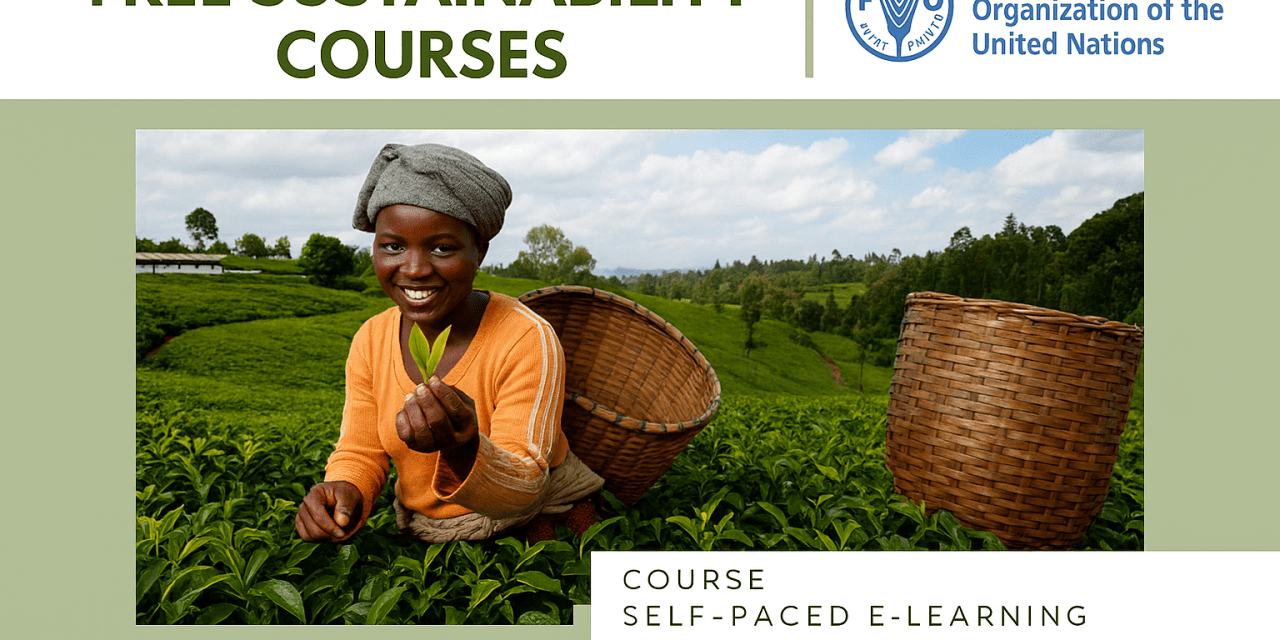
Call For Applications:  Food and Agriculture Organization (FAO) 20 Free Courses 

Blessing Joseph by Blessing Joseph
December 23, 2025
in News, Opportunities
0
Call For Applications:  Food and Agriculture Organization (FAO) 20 Free Courses 
Share

If you want to build practical skills in sustainable agriculture, climate-resilient food systems, or natural resource management, without cost the Food and Agriculture Organization of the United Nations (FAO) offers 20 free online courses that can help boost your knowledge and career prospects. These courses are ideal for students, young professionals, entrepreneurs, and anyone working in agriculture, food security, environmental planning, or related sectors.

Free, self-paced, and globally accessible, these courses can strengthen your credentials while you contribute to sustainable development goals (SDGs) in your community or business.

These courses are not only knowledge resources — they provide credible credentials from a UN agency, making them valuable for CVs, internships, job applications, and entrepreneurial development.

What You Get (Benefits)

✔ Free Access

No fees, no subscription — learners can enroll at no cost through FAO’s online platform.

✔ Practical Training

Course content emphasizes real-world agricultural and sustainability solutions used by governments, NGOs, and agribusinesses.

✔ Self-Paced Learning

Complete lessons on your own schedule — ideal for students, entrepreneurs, and working professionals.

✔ Certificate of Completion

Students receive certificates that demonstrate enhanced skills in areas such as climate-smart agriculture, food loss reduction, and sustainable resource management.

✔ Credibility from a UN Agency

FAO is a globally recognized authority in food and agriculture — completion certificates carry institutional credibility.

Topics Covered

FAO’s free sustainability courses span core themes including:

  • Sustainable agriculture and climate-smart farming
  • Food safety and risk management
  • Nutrition and food systems
  • Fisheries and aquaculture sustainability
  • Forest and land restoration
  • Value chain resilience
  • Water management and irrigation
  • Gender in agriculture and inclusive practices

These courses offer a mix of introductory modules and deeper technical insight, suitable for learners at multiple levels.


Who Should Take These Courses (Use Cases)

These courses are especially valuable for:

  • Students studying agriculture, environmental science, economics, or sustainability
  • MSME founders or agripreneurs building resilient food or eco-businesses
  • Community organisers and NGO staff focused on food security or climate adaptation
  • Policy practitioners needing clarity on sustainable food system frameworks
  • Job seekers looking to strengthen their résumé with sector-relevant training

No formal prerequisites are generally required — only interest in sustainability and commitment to learning.


How to Enroll (Step-by-Step)

1. Visit the FAO course platform

Go to the official FAO online learning portal

  1.  Food Insecurity Experience Scale (FIES)
    Learn how the FIES is used as an SDG indicator to measure food insecurity worldwide.

  2. Sustainable Agriculture
    Understand sustainable agriculture methodologies and reporting for SDG Indicator 2.4.1.

  3. Securing Sustainable Small-Scale Fisheries
    This course focuses on monitoring progress for SDG Indicator 14.b.1 on small-scale fisheries sustainability.

  4. Fish Stocks Sustainability
    Learn about managing and reporting on biologically sustainable fish stocks.

  5. Labour Productivity & Income of Small-Scale Food Producers
    Covers SDG Indicators 2.3.1 and 2.3.2 related to productivity and income levels.

  6. Food Loss Index
    Explore how food loss is measured and strategies to reduce it in supply chains.

  7. Prevalence of Undernourishment (PoU)
    Dive into SDG Indicator 2.1.1 — prevalence of undernourishment — and its global implications.

  8. Change in Water-Use Efficiency Over Time (SDG 6.4.1)
    Focuses on measuring improvements in how water is used across sectors.

  9. Plant and Animal Genetic Resources (SDG 2.5.1 & 2.5.2)
    Support for analyzing and reporting genetic resource indicators.

  10. Equal Tenure Rights for Women on Agricultural Land (SDG 5.a.1)
    Understand data, methods, and policy contexts for land tenure equality.

  11. Agriculture Orientation Index (SDG 2.a.1)
    Learn how budget orientation affects agriculture performance.

  12. Introduction to SDG Indicators Under FAO Custodianship
    A great starter course on how FAO supports global SDG monitoring.

  13. Ensuring Women’s Legal Rights to Land Ownership and/or Control (SDG 5.a.2)
    This course explores women’s land rights and reporting methods.

  14. Level of Water Stress (SDG 6.4.2)
    Learn about measuring and analyzing water stress.

  15. Forest Area & Sustainable Forest Management (SDG 15.2.1)
    Focus on forest indicator monitoring and sustainability.

  16. Food Price Anomalies (SDG 2.c.1)
    Explore methods to analyze sudden food price changes.

    1. Stakeholder Engagement – Learn about participatory methods in sustainability.

    2. Voluntary National Reviews & the High-Level Political Forum – For policymakers tracking SDG progress.

    3. Initial Preparation & Organization of Voluntary National Reviews

    4. Voluntary National Reviews Assessment and Analysis

2. Browse the available courses

Select courses that align with your interests and career focus.

3. Register or sign in

Create a (free) account with FAO’s training platform if required.

4. Begin learning

Courses are self-paced — you can complete them around your schedule.

5. Obtain your certificate

After finishing course requirements, download your certificate and use it to demonstrate your sustainability skills.

Post Views: 47
Share

Related Posts:

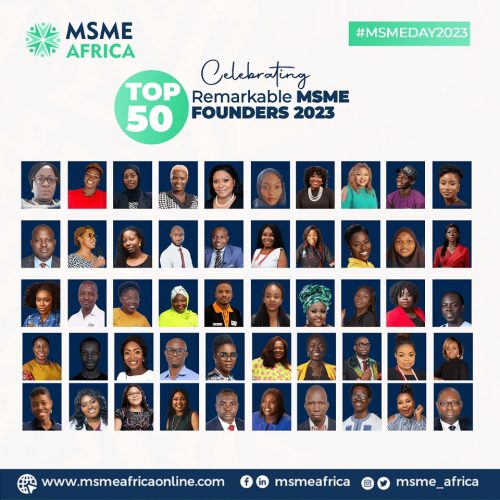
  • MSME Africa Unveils Top 50 Remarkable MSME Founders 2023, Awards them $25,000 in Media Credits
    MSME Africa Unveils Top 50 Remarkable MSME Founders…
  • Best Cities to live as an Entrepreneur in Nigeria
    Ultimate 2025 Guide to the Top Business Enabling…
  • Africa must prepare for the inevitability of a global food crisis - Akinwumi Adesina
    Overcoming Binding Constraints to Competitive…
  • Top 15 Social Media Marketing Tools for Nigerian Entrepreneurs
    15 Social Media Management Tools That Will Make Life…
  • #IWD2023: Celebrating Outstanding Women in Micro Small and Medium Enterprises
    #IWD2023: Celebrating Outstanding Women in Micro…
  • How African Startups Can Secure Funding in Tough Markets
    How African Startups Can Secure Funding in Tough Markets
Tags: AgriEducationClimateSmartAgricultureFAOFreeCoursesFoodSystemsGreenJobsMSMEafricaOnlineLearningAfricaSustainabilityTrainingSustainableDevelopmentUNLearning
Previous Post

Call For Applications: She Leads African Food Futures (SHEAF) Fellowship 2026 for African Women in Agri-Food 

Next Post

Instagram Now Limits Posts and Reels to Five Hashtags to Improve Discovery

Next Post
Instagram Now Limits Posts and Reels to Five Hashtags to Improve Discovery

Instagram Now Limits Posts and Reels to Five Hashtags to Improve Discovery

Leave a Reply Cancel reply

Your email address will not be published. Required fields are marked *

No Result
View All Result
Join MSME on Whatsapp
Subscribe To Our Newsletter
Enter your email to receive a weekly round-up of our best posts. Learn more!
icon
By subscribing, you agree with our privacy policy and our terms of service.

Recent Posts

  • Luno and AltSchool Africa Launch Fully Funded Crypto Education for 15,000 Nigerians
  • FIRS Declares NIN as Automatic Tax ID for Nigerians to Simplify Tax Compliance: What MSMEs Should Do
  • Swedfund Commits $20m to Helios CLEAR Fund to Back Africa’s Greentech Startups
  • Oyo Governor Seyi Makinde Signs N892 Billion 2026 Budget into Law, Prioritises Production-Led Growth
  •  Misinformation on Gazetted Tax Law Is Fueling Fear, Undermining Confidence; Oyedele Warns

Recent Comments

  • 10 Reasons Why SMEs Should Invest in Video Marketing - MSME Africa on How to Create Viral Videos for Social Media in 2024
  • link alay4d on 5 Nigerian-based Companies Providing Accelerator Programs for Startups in 2024
  • Damilare Oladeji on Nigerian Government Agencies that Support Entrepreneurship in 2024
  • situs alay4d on 50 Best Tools to Boost Your Productivity as an Entrepreneur in 2025
  • Otabor Osayomore Blessing on Ultimate 2025 Guide to the Top Business Enabling Cities for Startup Founders and Entrepreneurs in Nigeria
  • About us
  • Advertise with Us
  • Contact Us
  • Home
  • News
  • Newsletter
  • Submit News
  • Terms of Use

© 2023 MSME Africa - All rights reserved.

No Result
View All Result
  • Home
  • News
  • Business
  • Financial Services
  • Opportunities
  • About Us

© 2023 MSME Africa - All rights reserved.