

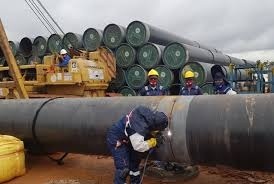
The Nigerian National Petroleum Company Limited has completed the main pipeline of the Ajaokuta–Kaduna–Kano gas project, marking a major step toward expanding gas supply and industrial energy access across northern Nigeria after years of delays and technical setbacks.
The Group Chief Executive Officer of NNPC Limited disclosed the development after a meeting with President Bola Tinubu in Lagos, describing the completion as a turning point that allows the company to move into the next phase of the project. That phase involves linking facilities and building distribution infrastructure needed to deliver gas to key northern cities and industrial hubs.
According to NNPC, finishing the main line followed the resolution of long-standing engineering challenges, most notably the successful crossing of the River Niger, a segment that had stalled progress for several years. The company said completing this backbone now makes it possible to begin connecting industrial users and power-related infrastructure in the coming months.
The AKK pipeline is expected to supply gas to major locations including Ajaokuta, Abuja, Kaduna and Kano, areas seen as critical to Nigeria’s industrial expansion plans. NNPC said the project will support gas-based industries such as fertiliser production, manufacturing clusters, industrial parks and power generation, helping to unlock economic activity in regions that have historically been constrained by limited energy infrastructure.
The company also linked the milestone to broader improvements in its operational performance, pointing to recent gains in oil and gas output. Oil production has increased from around 1.5 million barrels per day in 2024 to over 1.7 million barrels per day in 2025, while gas production has risen from about 6.5 billion standard cubic feet per day to more than 7 billion standard cubic feet per day. NNPC attributed the growth to internal restructuring, stronger governance and renewed investment focus.
For businesses, particularly manufacturers and agro-processing firms in the North, the completion of the main pipeline line raises expectations of more reliable and affordable gas supply, which could reduce dependence on diesel and other costly energy sources. Analysts say this could improve competitiveness for small and medium-scale enterprises operating in industrial clusters once the distribution infrastructure is fully connected.
NNPC said its priority for 2026 is to further increase oil and gas production by attracting new investments, with a target of at least 1.8 million barrels per day in oil output next year. The company added that the Federal Government has set a broader goal of attracting $30 billion in energy investments by 2030 and raising oil production to two million barrels per day by 2027, positioning the AKK pipeline as a strategic asset in achieving those targets.
The AKK pipeline, which spans about 614 kilometres and is designed to transport up to 2.2 billion standard cubic feet of gas per day, is seen as a critical link in Nigeria’s gas infrastructure network. With the main line now completed, attention will shift to how quickly connections, distribution systems, and end-user facilities can be delivered to translate the milestone into tangible economic impact.
While challenges remain around timelines, security, and downstream readiness, the completion of the AKK main line is widely viewed as a significant step toward deepening gas utilization, supporting industrial growth, and advancing Nigeria’s long-term energy transition objectives, particularly in the northern part of the country.