

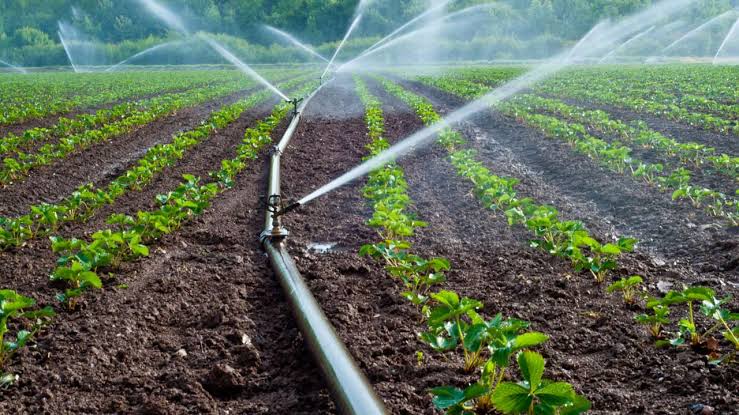
Agriculture remains the backbone of Nigeria’s economy, employing over a third of the population. Yet unpredictable weather, poor infrastructure, and limited irrigation have long made farming uncertain. The Transforming Irrigation Management in Nigeria (TRIMING) project is changing that, expanding irrigated farmland across 43,400 hectares, producing enough food to feed one million people.
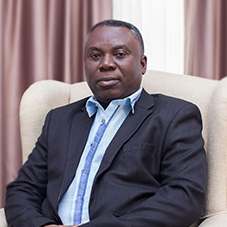
For Mustapha Adamu, who leads a Water Users’ Association in Kano State, the difference is striking. “Ten years ago, farming this 6,000-hectare land was a tough task. Poor access to water and unpredictable weather made each planting season uncertain,” he recalls. Today, with TRIMING support, farmers like him can irrigate more efficiently, improve productivity, and manage resources better.
The project, led by Nigeria’s Federal Ministry of Water Resources and Sanitation and financed by the World Bank’s International Development Association, has modernized irrigation systems, strengthened water management, and upgraded infrastructure. Farmers have seen yields double in some areas. Musa Idris of Jigawa State says, “Before the project, we got 15 to 20 bags of rice per acre. Now, we get between 30 and 35 bags.”
TRIMING’s impact goes beyond crop yields. Irrigation canals were cleared, access roads repaired, and over 800 Water Users’ Associations were established to collectively manage water resources. Women farmers, historically underrepresented, are now active participants. Hajiya Ramatu, deputy leader of a women’s group, points to a row of rice she planted, saying proudly, “We are going to make some good money from it.” Her group expanded farmland from 22 to 37 hectares, and her son is now attending university thanks to the improved income.
The program also addresses climate and economic pressures. With Nigeria’s population projected to reach 400 million by 2050, food demand is expected to rise by over 50%. Yet less than 1% of Nigeria’s farmland is irrigated. By using available water efficiently, projects like TRIMING help farmers grow more crops with less land and water while reducing vulnerability to climate shocks.
Building on TRIMING’s success, the follow-on Sustainable Power and Irrigation for Nigeria project aims to scale up irrigation even further, targeting 500,000 hectares by 2030. By expanding irrigation, improving water management, and supporting smallholder farmers, Nigeria is taking key steps toward a more food-secure future, resilient agriculture, and stronger rural livelihoods.
For farmers like Mustapha Adamu and Hajiya Ramatu, the benefits are tangible: higher yields, better incomes, and increased food security despite a changing climate. Irrigation is not just about water, it is about empowering communities and feeding a growing nation.