

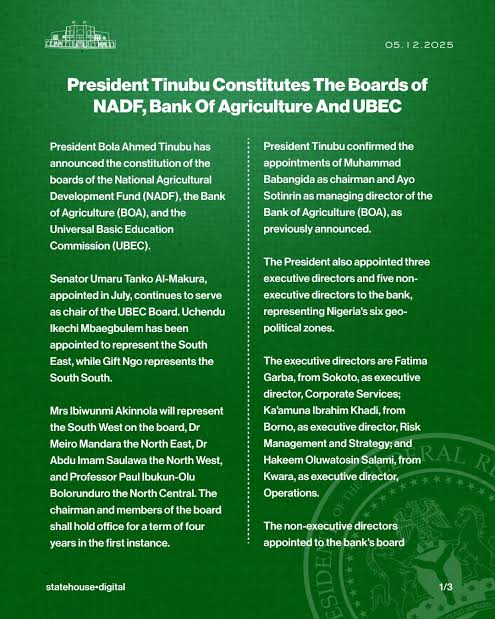
Nigerian Government has approved the constitution of governing boards for the Bank of Agriculture, the National Agricultural Development Fund and the Universal Basic Education Commission, marking a fresh phase of administrative restructuring aimed at improving agricultural financing and basic education delivery in the country. The appointments were confirmed in a statement by the Special Adviser to the President on Information and Strategy.
The Bank of Agriculture board now has a chairman, a managing director, three executive directors and five non-executive directors drawn from all six geopolitical zones. The appointments, previously announced at leadership level, are now backed by a full board structure expected to enhance operations, risk management and corporate strategy, with the aim of repositioning agricultural credit to farmers and agri-businesses.
For the National Agricultural Development Fund, created to expand affordable capital access for agripreneurs, the President has ratified the appointment of its executive head and named members of its governing council. The board includes individuals with backgrounds in finance, business, engineering, agriculture and corporate management. The Fund, established in 2023, is mandated to catalyse financing for primary producers and agro-value chain enterprises through long-term funding support.
The Universal Basic Education Commission board has also been confirmed, with the chairman earlier appointed and additional members selected to represent Nigeria’s geopolitical zones. They will serve a four-year term in the first instance, and are expected to guide policy implementation, resource allocation and quality standards across basic education systems nationwide.
The constitution of the three boards signals a renewed governance drive within key development institutions. For micro and small agribusinesses, strengthened leadership in BOA and NADF could translate to more structured credit pipelines, better financing frameworks and improved access to agricultural support programmes. In education, a functional UBEC board holds potential for accelerated basic education funding, infrastructure upgrades and stronger literacy foundations that shape the future workforce.
If effectively implemented, these appointments could contribute to rural productivity, value-chain development and long-term human capital growth, supporting broader economic reforms and Nigeria’s development agenda.