

Nigerians are emerging as the world’s most enthusiastic adopters of artificial intelligence, using the technology far beyond search and entertainment and increasingly as a tool for education, career advancement and entrepreneurship, according to a new report by Google and Ipsos.
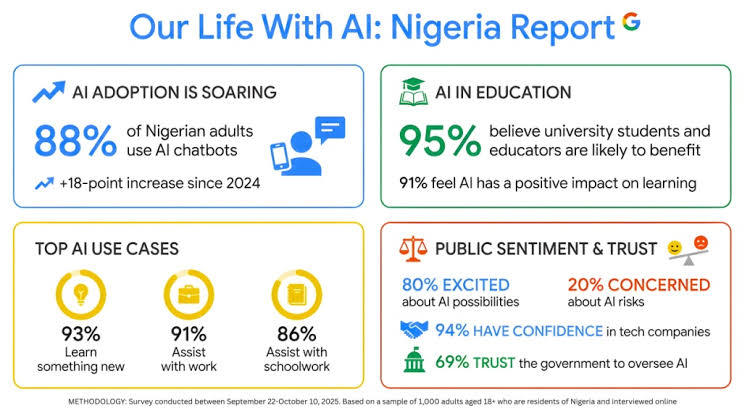
The study, titled Our Life with AI: Helpfulness in the Hands of More People, shows that 88 per cent of Nigerian adults have used an AI chatbot, an 18-point increase from 2024 and well above the global average of 62 per cent. The findings position Nigeria among the most AI-forward countries globally, reflecting how rapidly the technology is being integrated into everyday life.
The report indicates that AI adoption in Nigeria is closely tied to economic necessity and opportunity. About 80 per cent of Nigerians surveyed said they use AI to explore new business ideas or support a career transition, almost double the global average of 42 per cent. This suggests that for many Nigerians, AI has become a practical tool for navigating a challenging job market, building side businesses and improving productivity.
Education is another area where adoption is particularly strong. The data shows that 93 per cent of Nigerians use AI to understand complex topics, compared with 74 per cent globally, while 91 per cent of the workforce rely on AI for professional tasks. A significant majority of respondents also believe that students and educators stand to benefit the most from AI, reflecting widespread acceptance of the technology as a learning aid rather than a threat.
Unlike debates in some advanced economies, where AI use in schools is often associated with concerns about academic integrity, most Nigerians view the technology positively. The report found that 91 per cent of respondents see AI as a helpful tool for accessing information, far higher than the global average of 65 per cent.
Overall sentiment toward AI in Nigeria is also markedly optimistic. About 80 per cent of respondents expressed excitement about the technology’s potential, with only a small minority expressing concern. Among frequent AI users, optimism rises even further, suggesting that hands-on experience is reinforcing confidence rather than fear.
Industry observers note that this optimism is driven by Nigeria’s structural challenges, where AI is increasingly viewed as a way to bridge gaps in education, healthcare, financial services and small business support. For entrepreneurs and small enterprises, AI tools are already being used to improve customer engagement, manage operations, analyse data and reduce costs, making advanced capabilities accessible to businesses with limited resources.
As global interest in AI investment continues to grow, Nigeria’s high adoption rate and positive outlook could strengthen its appeal to foreign investors and technology partners. A large, young and digitally confident population positions the country as a potential hub for AI-driven startups, applied research and innovation across Africa.
Google has indicated that Nigeria’s experience with AI adoption offers lessons for other emerging economies seeking to digitise their workforces and expand access to technology. With usage accelerating and optimism running high, Nigeria’s approach to AI is increasingly seen not just as rapid adoption, but as purposeful use aimed at economic resilience and growth.